
Where nothing stays hidden.
One hosting surface for the docs, wikis, and static reports a team would otherwise scatter across three different tools, published by hand or straight from a pipeline.
BooDocs exists because documentation always ends up everywhere: a rendered site here, a wiki nobody remembers the URL for, a coverage report that only ever lived inside a CI job's disposable output. It gives all of that one durable, browsable home, and a way to publish it that a machine can call too.
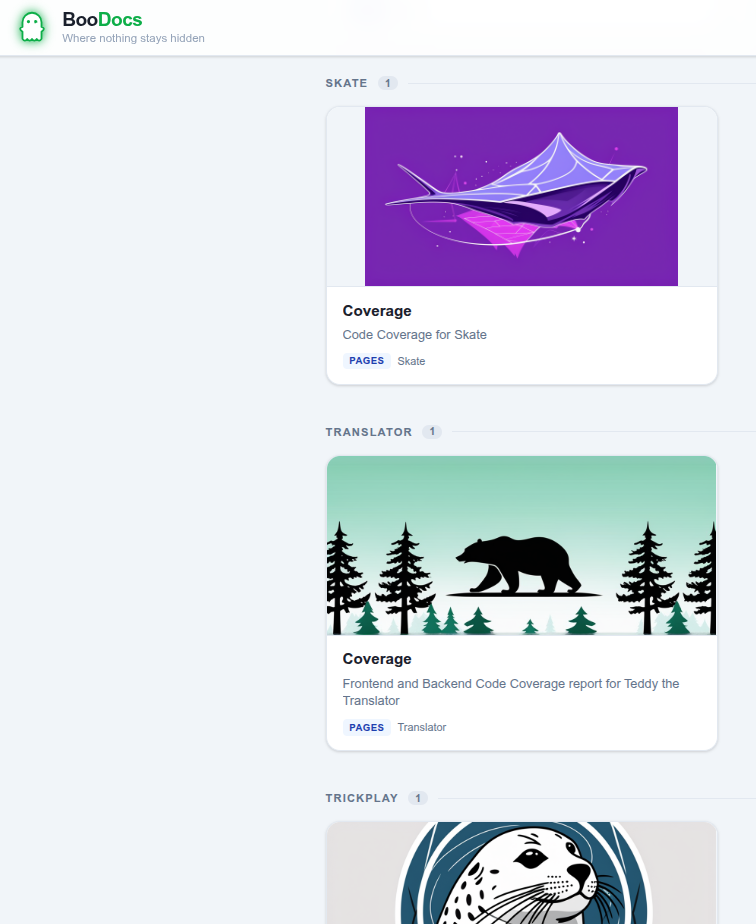
Every deployment grouped and labeled, not a pile of unlabeled folders.
Reading it back is just browsing: a home page groups every deployment by project, each one landing on a rendered docsify site, a full wiki, or a plain static folder like a coverage report. Publishing it is where the two doors in are: drop a zip in the admin panel by hand, or send it to a plain HTTP API secured by a shared key, built for a CI/CD job to call with nobody watching.
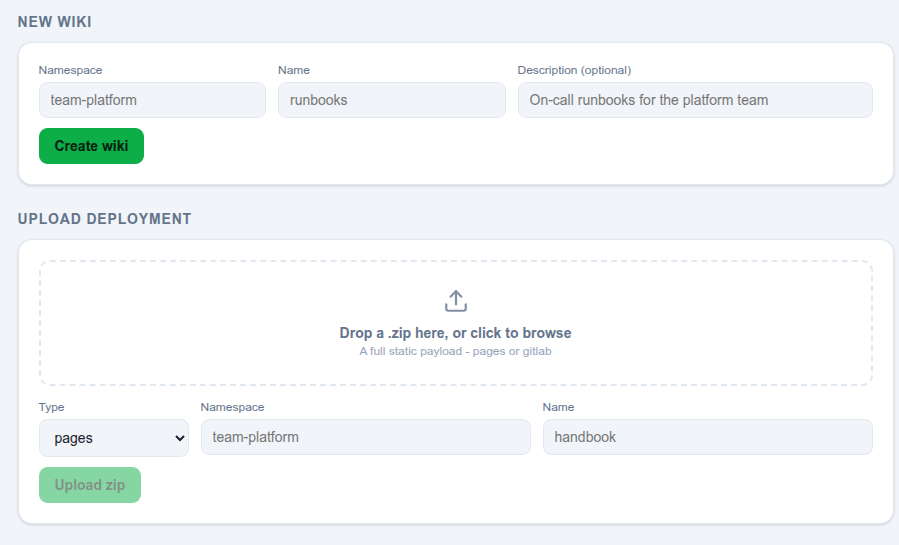
Spin up a new wiki by name, or drop a zip and choose where it lands.
Underneath, a docs site, a wiki, and a static bundle are all the same thing: a folder of files that shows up at a URL, some rendered on the way out, some served exactly as uploaded. That's what lets one small API handle all of it, a zip in, a URL out, whether a person dragged the file into a browser or a pipeline posted it the moment tests passed.
The real payoff is what that unlocks: a coverage report or a manual can land automatically the moment a release ships, instead of depending on someone remembering to publish it by hand. Updating the docs stops being an afterthought and becomes a normal step in shipping.
What it does
- Three kinds of content, one host: rendered docsify sites, full wikis with page history and cross-linking, and flat static bundles
- Zip-and-go publishing, by hand in the admin panel or by a single authenticated API call
- The same publish path for people and pipelines, so a release can publish its own docs as part of shipping
- An organized home page: every deployment grouped and labeled instead of piling into an unbrowsable link dump
- Soft delete, so a bad publish or an accidental removal isn't a full loss
- Gated publishing, open reading: managing content sits behind authenticated access, browsing it doesn't